Ball Brawl 3D - Soccer Cup
- 4.4
- Rating
- 10.00M
- Installs
- Free
- Price

 Analysis by App-foxy
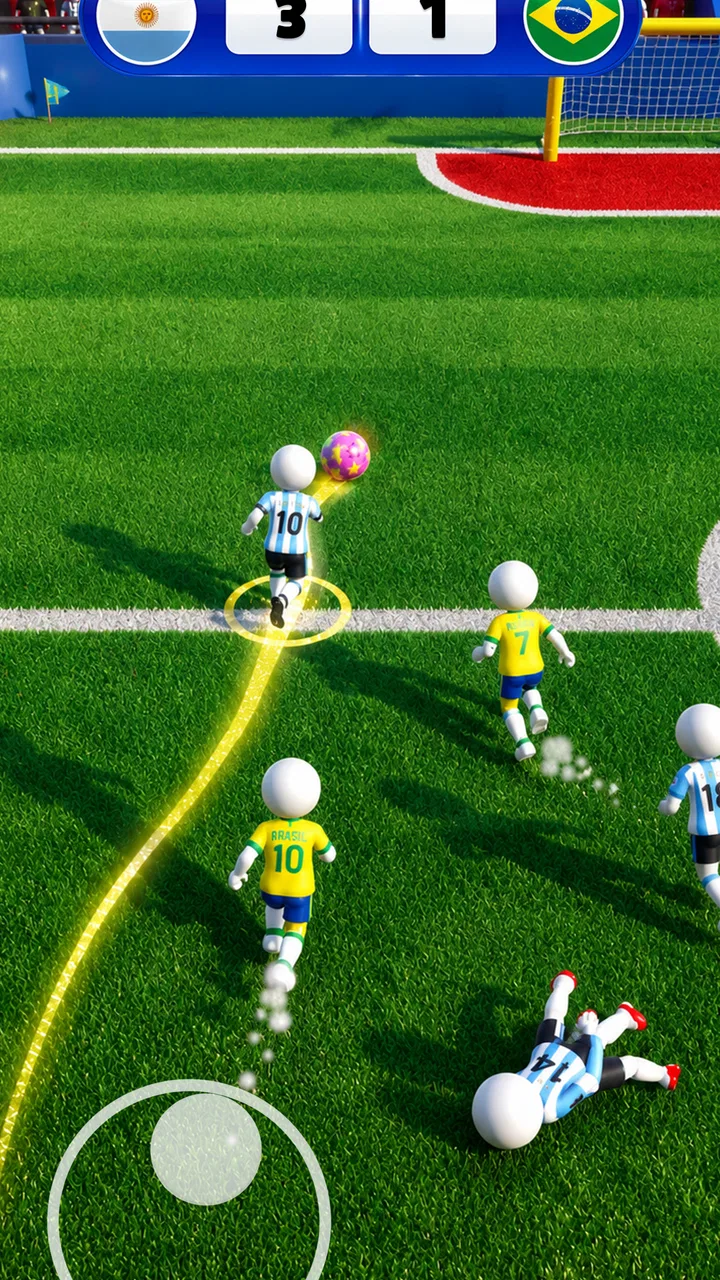
I approached Ball Brawl 3D - Soccer Cup expecting a quick sports game rather than a full football simulation, and that expectation shaped my experience in a useful way. This is a free soccer game from Panteon built around short, direct play and the simple appeal of chasing a better score. It is available for Everyone, runs on Android 7.0 or later, and its current version is 1.62.
The basic attraction is easy to understand: you step into a compact soccer challenge, try to score, and repeat the attempt with the aim of doing better. The game does not ask me to learn a large squad, manage a club, or study a complicated control system before I can enjoy it. That makes it a natural fit for brief sessions, especially when I want something more interactive than scrolling but less demanding than a traditional football title.
After spending time with it, my opinion is fairly clear. This is best viewed as an arcade-style score-chasing game, not a replacement for a full soccer simulator. Its strongest quality is the speed with which it gets me into the action. Its main weakness is that players looking for deep tactics, realistic match management, or a long-form career structure may find the experience too narrow.
You May Also Like

 Google Keep - Notes and lists
Google Keep’s Quiet Growth Shows the Appeal of Simpler Notes
As mobile work gets busier, Google Keep keeps winning a simple contest: capture a thought quickly, find it later, and get on with the day.

 Blood Strike: 2.5 Anniversary
Blood Strike’s Loadouts Turn Every Drop Into a Tactical Gamble
A close look at Blood Strike’s custom loadouts: how fast access to signature weapons reshapes its battle royale rhythm, rewards preparation, and narrows the gap between fights.

 Pandora - Music & Podcasts
Pandora’s Music Is Easy to Start, but Harder to Recover
Pandora’s strength is its low-effort path from a seed to a station. Its weak spot is how much confidence it asks you to place in connection, setup, and quiet recovery.

 8 Ball Pool
 Is Built on Rivalries, Rematches, and Routine
A close look at the rivalries, rematches, shared routines, and unanswered safety questions that turn a quick pool match into a persistent mobile community.

 Samsung Music
’s Quiet Strength Is Playing What You Already Own
Its reach comes less from spectacle than from dependable access to a personal library. That simplicity is both the app’s strongest retention engine and its ceiling.

 AccuWeather: Weather Radar
AccuWeather Review: A Quick, Clear Forecast for Everyday Decisions
For everyday plans, the best forecast is the one you can understand quickly. AccuWeather makes rain timing, radar, and local conditions easy to act on, with a few trade-offs.
More From Our News Desk



How the first goals shape the experience
The opening appeal comes from the first few successful attempts. Scoring gives the game an immediate sense of purpose, and that early feedback matters because the overall format is deliberately simple. I do not need to spend a long time preparing a lineup or learning a rule-heavy system. I can focus on the next shot and the next opportunity to improve.
That simplicity also makes the game approachable for people who do not usually play sports games. Someone can pick it up during a short break, understand the central objective quickly, and decide within minutes whether the style suits them. The Everyone age rating reinforces that accessible positioning, although younger players should still be aware that optional in-app purchases are available.
What I like about the early stage is the absence of unnecessary ceremony. The game’s store summary describes it as a no-rules soccer experience, and that is a useful way to understand its priorities. It is not trying to recreate every part of a regulated match. Instead, it puts the spotlight on the satisfying part of soccer for many casual players: creating a chance and getting the ball into the goal.
That focus works particularly well in an everyday situation. If I have a few minutes before an appointment, I can play a small number of attempts without committing to a full match. If I make a mistake, the cost in time feels low, so restarting does not feel like a major setback. This is one reason the game is more convenient than a larger football title when I only want a quick distraction.
There is a trade-off, though. The same streamlined design that makes the first goals approachable can also make the early sessions feel lightweight to experienced sports-game players. If your enjoyment comes from building attacks through several passes, controlling a whole team, or reacting to a living opponent, this format may seem limited from the beginning.
Why the score matters more than the match
The word “score” is important here because the game’s motivation is closer to beating a personal result than completing a conventional ninety-minute contest. That changes how I judge success. I am not asking whether the team has believable formations or whether the referee behaves realistically. I am asking whether each new attempt gives me a reason to concentrate a little more than I did on the previous one.
For casual play, that can be enough. A single good run creates a small target for the next session, and the short format makes improvement feel reachable. I can return after a break without needing to remember a complex campaign state or a long list of objectives. The game’s identity is therefore strongest when I treat it as a focused arcade challenge rather than as a miniature version of console football.
Progress signals and the value of unlocking more
Progression is most satisfying when the game makes improvement visible. In this kind of sports title, goals and unlocks need to do more than decorate the experience; they need to tell me that continued play has a purpose. Ball Brawl 3D - Soccer Cup benefits from that general structure because the next attempt is not only about repeating the same action. It is also about moving forward and seeing what the next stage of play offers.
I found that the clearest progress signal is the relationship between performance and access. When a successful attempt contributes toward reaching another part of the game, the result feels more meaningful than a goal that disappears without consequence. That gives ordinary play a rhythm: try, learn from the outcome, improve the result, and continue.
The important point is that progression does not need to be complicated to be effective. A casual game can keep me interested with modest steps if those steps arrive often enough and feel connected to what I am doing. The danger is the opposite: if an unlock feels too distant, or if it does not noticeably change the experience, the motivation can flatten quickly.
This is where I would set realistic expectations. The game is not the right choice for someone who wants a detailed player-development system or a deep management layer. Its appeal lies in immediate play and visible forward movement, not in constructing a football world over dozens of hours. Players who prefer a large career mode should choose a more comprehensive soccer game instead.
One useful habit is to treat each session as a small experiment rather than mindlessly repeating attempts. I pay attention to what caused a failed chance, then adjust my timing or approach on the next try. That turns progression into a personal learning loop instead of relying only on unlocks to provide motivation. It is a small distinction, but it helps the game remain engaging after the novelty of the first goals fades.
How to make short sessions feel worthwhile
I would recommend setting a simple session goal before starting. For example, I might play until I improve my previous result, reach the next meaningful progression point, or complete a few focused attempts without chasing perfection. This approach suits the game’s compact structure better than expecting a long, uninterrupted play session to deliver the same depth as a full sports simulation.
Another practical tip is to stop after a strong improvement instead of immediately grinding until the experience becomes frustrating. Score-chasing games can encourage “one more try” for a long time, but the quality of each attempt usually matters more than the number of attempts. Ending on a good result gives me a clear target for the next visit and keeps the game from feeling like a chore.
Players should also consider the purchase model before settling into a routine. The game is free to download and play, while individual in-app purchases range from $0.99 to $49.99. I would approach those options carefully and decide in advance whether I am comfortable spending anything. The free entry point is a strength, but the presence of a broad purchase range means families should use the platform’s purchase controls if children may play on the device.
Difficulty, mistakes, and the changing pace
A good arcade sports game needs a difficulty curve that makes early success possible without making later progress automatic. Ball Brawl 3D - Soccer Cup works best when I let the challenge gradually become the reason to concentrate. The first goals establish confidence; later attempts ask whether I can reproduce that success when the situation becomes less forgiving.
That shift is important for retention. If every attempt were equally easy, there would be little reason to improve. If the challenge rose too sharply, the game would turn from inviting to irritating. My experience is that the game’s value depends on finding the point where a miss feels like information rather than punishment. When I can understand why an attempt failed, I am more willing to try again.
The pacing also benefits from the game’s narrow focus. Because I am not managing multiple layers at once, I can concentrate on the immediate challenge. That makes a mistake easy to identify emotionally, even when I do not analyze it in technical terms: I rushed, misjudged the opportunity, or failed to repeat the action that worked earlier. The next attempt then has a clear purpose.
Still, the difficulty curve will not satisfy everyone. Players who want opponents with complex behavior, tactical surprises, or a highly realistic sense of match momentum may find the challenge too mechanical. Conversely, people who dislike repeating attempts after a failure may lose interest once the early progress stops arriving easily. The game asks for patience with repetition, even though it keeps the individual sessions short.
I also think the pacing is more suitable for mobile play than for a long evening dedicated exclusively to soccer. Its appeal comes from quick concentration and repeated improvement, not from creating a dramatic match narrative. That distinction explains why I would recommend it for commuting, waiting rooms, or short breaks, but not necessarily as my only football game.
When the challenge becomes a strength or a weakness
The challenge is a strength when I am in the mood to refine one narrow skill. I can return with a specific intention, such as being more patient or making a cleaner attempt, and the compact format lets me test that intention immediately. This is more rewarding than simply tapping through content because the result feels connected to my choices.
It becomes a weakness when I want variety without having to create it myself. A broader sports game may offer different teams, match situations, tactical decisions, and longer-term objectives. Here, the central loop carries most of the weight. If that loop does not appeal to me, additional progression will not completely solve the problem.
Retention pressure and the free-to-play balance
The game’s retention design is easy to understand: quick attempts, a visible score, progression, and the possibility of returning to improve. That combination can be effective because it respects short attention windows while still offering a reason to come back. I do not need to schedule a large block of time to feel that I have made progress.
At the same time, score-based games can create pressure through repetition. The temptation to replay after a near-success is powerful, particularly when the next goal seems close. I enjoy that tension in moderation, but I would not recommend playing indefinitely just to overcome one stubborn result. A short break can be more useful than forcing another attempt while frustrated.
The free model makes experimentation easy. Since the game costs nothing to start, I can see whether its style fits me before spending anything. That is especially valuable for players who are unsure whether they prefer arcade soccer or a more traditional football game. The optional purchases do not change my basic recommendation, but they do make responsible spending part of the decision.
For parents, the Everyone rating makes the game broadly approachable, yet the purchase range still deserves attention. I would check device-level purchase protections before handing it to a child. That is not a criticism of the soccer mechanics; it is simply sensible preparation for any free game with optional paid items.
The game has also built a substantial audience, with over ten million installs and an average rating of 4.4 from around fifty-three thousand ratings. Those figures suggest that the short-form concept has connected with many players, but they should not replace personal judgment. A popular casual game can still be a poor fit for someone seeking realism, deep competition, or a long campaign.
Who should choose it, and who should skip it
I would recommend it to someone who wants a lightweight soccer challenge, enjoys chasing personal improvement, and prefers games that can be understood quickly. It is also a good option for players who like returning to the same core action and gradually getting better rather than learning a large system.
I would steer away from it if your priority is authentic football simulation. You will likely be happier with a game centered on full matches, team tactics, player roles, and a richer career structure. I would also suggest looking elsewhere if repetition quickly becomes boring for you, because the compact score-focused loop is the main attraction rather than a small part of a much larger package.
Another trade-off concerns attention. The game is convenient when I have only a few minutes, but its convenience can make it easy to play automatically. To get more from it, I need to approach each attempt with a purpose. That is the difference between a satisfying short session and a string of forgettable retries.
My progression verdict after playing
Ball Brawl 3D - Soccer Cup succeeds when it stays close to its central promise: quick soccer action, immediate goals, and a reason to improve the next result. Panteon has positioned it as a casual sports game rather than a detailed simulation, and that focus gives it a clear audience. The early goals are accessible, the progress loop can make repeated attempts worthwhile, and the difficulty has enough room to turn simple play into a modest skill challenge.
Its limitations are equally clear. The experience may feel too narrow for football fans who want complete matches or strategic control over a team. The repetition can also become tiring if the score-chasing loop does not naturally appeal to you. Optional purchases, ranging from $0.99 to $49.99 per item, are another reason to make deliberate choices rather than spending impulsively.
The game was released on May 6, 2019, and its continued presence alongside version 1.62 shows that it has remained a recognizable mobile sports option. I would not choose it for realism, but I would recommend giving it a try if you want a free, approachable way to fill short gaps in the day. Its best quality is not complexity; it is the clean feeling of making one attempt, learning from it, and wanting to make the next goal better.
In my view, the progression earns a positive but specific verdict. It sustains play when I treat the game as a focused arcade challenge and use each session to improve a result. It is less convincing as a long-term substitute for a complete soccer game. Download it for quick goals and compact challenges, not for club management or simulation depth, and you will have a much better idea of what it can—and cannot—offer.
My recommendation: a good free pick for casual soccer fans who enjoy short score-chasing sessions, provided they are comfortable with repetition and keep the optional purchases under control.
FAQs for Ball Brawl 3D - Soccer Cup
01What is Ball Brawl 3D - Soccer Cup about?
Ball Brawl 3D - Soccer Cup is a casual, soccer-themed game that offers a fun and engaging experience for players of all ages. It combines simple controls with entertaining gameplay, allowing users to participate in quick matches or tournaments. The game is designed to be easy to pick up, making it perfect for both quick sessions and longer playing times.
02Is Ball Brawl 3D suitable for all ages?
Yes, Ball Brawl 3D is designed to be family-friendly and suitable for all ages. Its simple controls and entertaining gameplay make it accessible for younger players, while the competitive elements can appeal to older audiences as well. It's a great way for families to enjoy some casual gaming together.
03Are there in-app purchases in Ball Brawl 3D?
Ball Brawl 3D does offer in-app purchases. These can include additional features, customization options, or in-game currency. While the game is free to download and play, these purchases can enhance the experience. It's important to manage in-app spending, especially if children have access to the device.
04Does Ball Brawl 3D require an internet connection?
Ball Brawl 3D can be played both online and offline. While an internet connection can enhance the experience by enabling multiplayer options and updates, you can still enjoy the core gameplay offline. This flexibility makes it a convenient choice for playing wherever you are, even without internet access.
05What devices are compatible with Ball Brawl 3D?
Ball Brawl 3D is available on both Android and iOS platforms. It requires a device running a relatively recent version of these operating systems to ensure optimal performance. Checking the app's requirements on the Google Play Store or Apple App Store before downloading will help ensure compatibility with your device.
Pros
- Engaging 3D graphics enhance the gameplay.
- Simple controls make it easy to pick up.
- Quick matches perfect for short sessions.
- Fun multiplayer mode with friends.
- Regular updates with new content.
Cons
- Ads can be frequent and intrusive.
- Limited customization options for teams.
- Some in-app purchases are costly.
- Occasional lag in online matches.
- AI opponents can be too predictable.

Ball Brawl 3D - Soccer Cup
Gallery